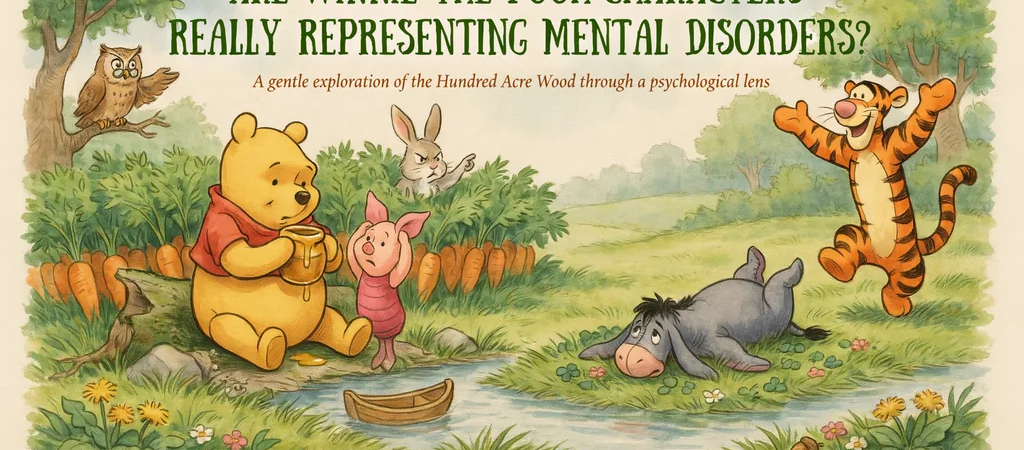
Have you ever wondered if the beloved friends from the Hundred Acre Wood are more than just storybook animals? For years, fans and even some experts have explored a famous theory: Pooh Characters and Mental Disorders might be linked [1.1.1, 1.2.2]. While these stories are meant to be sweet and innocent, some people see traits in each character that mirror common psychological conditions [1.1.4, 1.2.1].
This idea started as a lighthearted way to look at human behavior through familiar faces [1.2.2]. Whether or not the author, A.A. Milne, intended this, these theories help us talk about mental health in a kind and simple way [1.1.6]. Let’s dive into the Hundred Acre Wood to see how these classic friends might represent different parts of the human experience.
Exploring the Hundred Acre Wood Theory
The theory that pooh characters and mental disorders are connected gained popularity after a lighthearted academic paper suggested each friend displays specific signs of neurodivergence [1.1.4, 1.2.1]. It is important to remember that these are just observations, not official medical diagnoses [1.2.2]. Instead, they provide a unique lens to view how different personalities might handle challenges in life [1.2.2].
Winnie the Pooh: Impulsivity and Focus
Winnie the Pooh is the heart of the forest, but some suggest his constant hunger for honey and his forgetful nature point toward ADHD, inattentive type [1.1.4, 1.2.1]. His “fixation” on honey and repetitive habits are often cited as traits that might mirror an eating disorder or even obsessive tendencies [1.1.3, 1.1.6].
Piglet and the Nature of Anxiety
Piglet is small, shy, and often worried about what might happen next [1.1.4]. His constant state of fear and his nervous habits, like twitching, lead many to link him to Generalized Anxiety Disorder (GAD) [1.1.4, 1.2.1]. He reminds us that even the smallest friend can carry big worries.
Eeyore’s Struggle with Low Mood
Eeyore is famously known for his gloomy outlook and low energy [1.1.4, 1.2.2]. This has led many to associate him with depression or dysthymia [1.1.3, 1.1.4]. His character shows us how a “low mood” can impact daily life, yet his friends always make sure to include him.
Tigger’s Boundless Energy
Tigger is the opposite of Eeyore, with a personality that is always bouncing off the walls [1.1.3, 1.2.2]. Because he finds it hard to sit still and often acts without thinking, many link his character to ADHD, hyperactive subtype [1.1.4, 1.1.6]. He is full of life but can be quite restless.
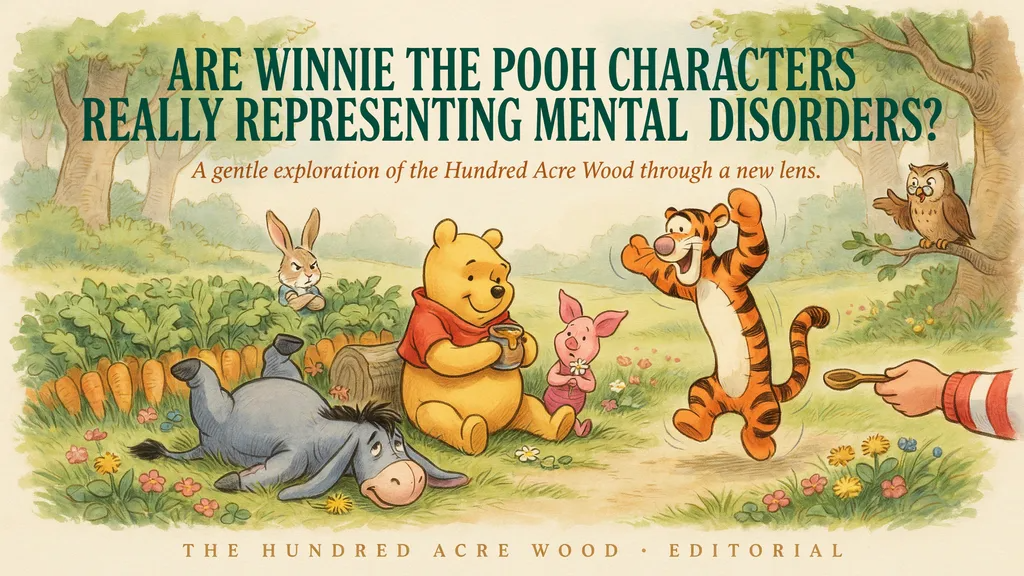
Rabbit and the Need for Order
Rabbit loves his garden and likes things done exactly his way [1.1.3, 1.2.2]. Because of his strict rules and desire for control, people often associate him with Obsessive-Compulsive Disorder (OCD) [1.1.1, 1.1.4]. He shows us that sometimes, a need for order is a way to cope with stress.
Owl and His Intellectual Pride
Owl often acts like the smartest one in the room, though he sometimes struggles with reading or forgetting details [1.1.3, 1.1.4]. Some suggest he might represent traits like dyslexia or narcissistic personality disorder [1.1.2, 1.1.4]. His story is a gentle look at how people process information differently.
Roo and Social Awareness
Little Roo is very curious and often follows Tigger’s lead without a second thought [1.1.3, 1.2.1]. Because he sometimes misses potential dangers, some speculate about autism spectrum traits [1.1.3, 1.1.4]. Like a child, he is still learning how to navigate the world around him.
Christopher Robin: The Imaginative Guide
As the only human, Christopher Robin is the one who brings the whole group together [1.1.4]. Some theories suggest that because these friends appear based on his mood, he might represent schizophrenia [1.1.3, 1.2.2]. However, most just see him as a symbol of childhood imagination.
Why This Theory Matters for Us
Why do we love looking at pooh characters and mental disorders? It makes complex topics feel less scary [1.1.6]. By seeing these traits in characters we love, we learn to have more patience and empathy for people in our own lives who might be struggling [1.1.5, 1.1.6].
A Note on Empathy and Care
While connecting pooh characters and mental disorders is interesting, we should always treat real mental health with care [1.2.2]. If you or someone you know feels like these characters in a way that is hard to handle, it is always okay to ask for help from a professional [1.2.2].
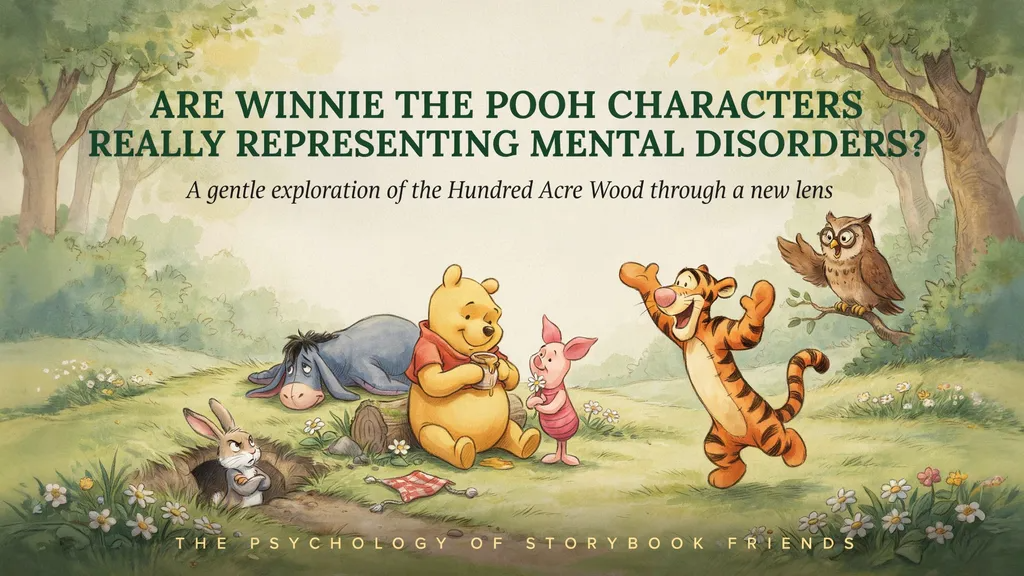
Frequently Asked Questions
1. Did the author intend for these characters to have mental disorders?
No, most experts believe A.A. Milne created them to be timeless, relatable characters, not medical case studies [1.1.5, 1.1.6].
2. Are these diagnoses official? No, these are fan theories and lighthearted observations, not professional medical diagnoses [1.2.2].
3. Why do people link Pooh to an eating disorder?
Because of his “fixation” on honey and his tendency to eat whenever he remembers food is available [1.1.6, 1.2.1].
4. Is this theory meant to be offensive?
Quite the opposite! Many feel it humanizes mental health by showing that everyone has their own unique struggles [1.1.6].
5. What does Eeyore represent?
Eeyore is most commonly associated with depression or a chronic low mood due to his gloomy nature [1.1.3, 1.1.4].
6. Can I use these characters to explain mental health to a child?
Yes, they are excellent for teaching kids that everyone has different needs and that we should be kind to one another [1.1.6].
Conclusion
The pooh characters and mental disorders theory gives us a special way to look at the Hundred Acre Wood. Whether it’s Piglet’s anxiety or Tigger’s energy, these friends remind us that everyone is different. They teach us that being “different” is just part of being human. If you found this article helpful, share it with a friend who loves Pooh! Let’s keep the conversation about kindness and mental well-being growing together.